
Check Engine Light Flashing? When It’s A Lemon Law Case
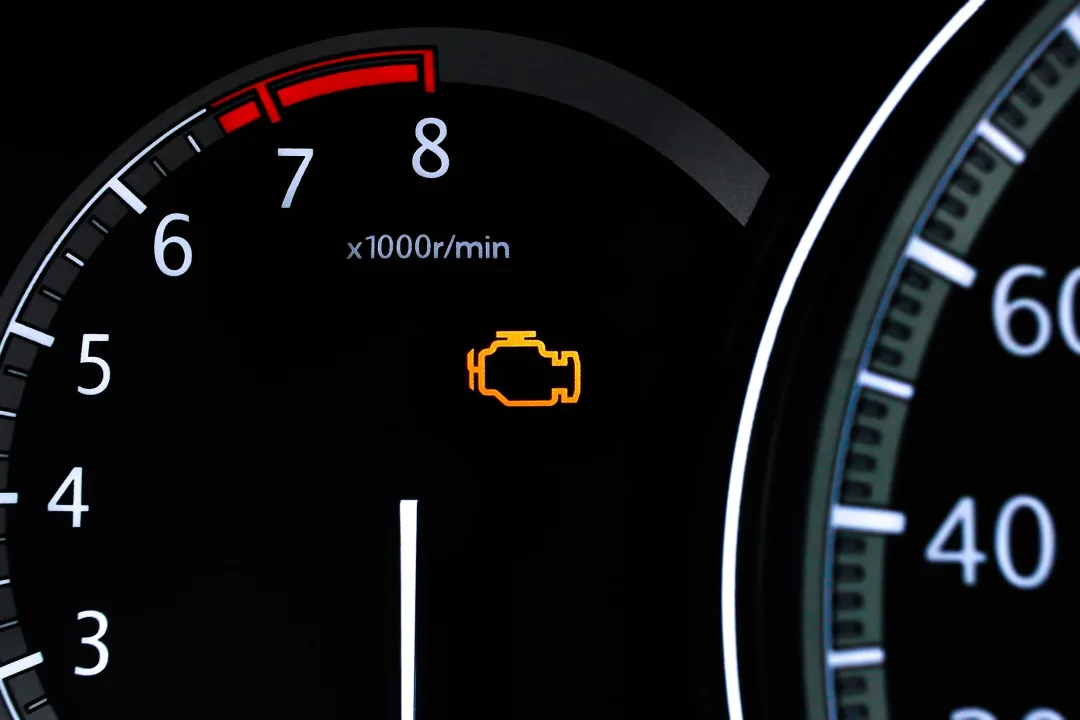
The service advisor hands you the keys and says the code is cleared. You make it eleven miles before the amber engine icon lights up the dash again.
That moment, the one where you realize the “fix” was a reset button, is where a lot of check engine light lemon law cases quietly begin. Most drivers don’t know it yet. They assume a warning light is a nuisance, not a legal problem. But under California law, a check engine light that keeps returning on a car still under warranty can be the first sign that you’re owed a refund, not another appointment.
Here’s how to tell whether you have a real check engine light lemon law case, what the manufacturer owes you, and what to do the next time that light comes on.
The Light Isn’t the Defect. What’s Behind It Is.
Let’s start with the honest part. A check engine light by itself is not a lemon. A loose gas cap that triggers the light once, gets tightened, and never comes back is not a claim. Neither is a single sensor that gets replaced and stays fixed.
The light is a messenger. Your car’s computer turns it on when it detects a fault in the engine, emissions, fuel, or ignition system. What matters for a check engine light lemon law claim is the problem underneath: a misfire, a failing catalytic converter, a bad oxygen sensor that keeps getting swapped, a fuel system leak, or a software fault the dealer can’t pin down.
The pattern that should get your attention looks like this:
- The light comes back after every repair visit.
- The dealer “cleared codes” or “could not duplicate” without fixing anything.
- The car runs rough, loses power, drops into limp mode, or burns more fuel.
- The same part has been replaced more than once.
If two or more of those sound familiar, stop thinking of this as bad luck. Start thinking of it as evidence.
Takeaway: Recurrence is the signal. One light is a repair. A light that won’t stay off is the start of a check engine light lemon law claim.
When Does a Check Engine Light Lemon Law Claim Start?
California’s lemon law, the Song-Beverly Consumer Warranty Act, protects you when a warranty defect substantially impairs the use, value, or safety of your car and the manufacturer can’t fix it after a reasonable number of tries. If that happens, the manufacturer has to replace the car or buy it back.
A recurring engine fault easily clears the “substantial impairment” bar. Think about what a lit check engine light actually does to your life in California. Your car can’t pass a smog check while that light is on, which means you can’t renew your registration. A car you can’t legally register has lost real value. Add stalling, hesitation, or limp mode, and you’re dealing with a safety issue too.
California also gives you a helpful shortcut called the presumption. Under Civil Code § 1793.22, your car is presumed to be a lemon if, within the first 18 months or 18,000 miles, one of these happens:
- The same defect has been through four or more repair attempts.
- A defect that could cause death or serious injury (like stalling on the freeway) has been through two or more attempts.
- The car has been out of service for repairs more than 30 total days.
Don’t treat those numbers as a minimum. They’re a shortcut, not a gate. Plenty of check engine light lemon law cases succeed outside that window, and you can still qualify after 18 months as long as the defect showed up and was reported while the car was under warranty. Our guide on how many repair attempts qualify a car as a lemon breaks this down in detail.
Takeaway: If your car has been back to the dealer three or more times for the same warning light, you’re already in check engine light lemon law territory.
You Don’t Have to Figure Out What’s Wrong. That’s the Manufacturer’s Job.
Here’s where many owners talk themselves out of a good check engine light lemon law claim. They think, “The dealer can’t even figure out what’s causing it. How am I supposed to prove anything?”
You don’t have to. In Donlen v. Ford Motor Co., 217 Cal. App. 4th 138 (2013), the California Court of Appeal laid out exactly what a consumer has to show. Your job is to prove three things: the car had a warranty defect that substantially impaired it, you brought it to an authorized dealer for repair, and the dealer didn’t fix it after a reasonable number of attempts.
Notice what’s missing from that list. You don’t have to name the failed part. You don’t have to explain the wiring. California’s jury instructions, which rely on Donlen, say it directly: the consumer doesn’t need to prove the cause of the defect.
That matters enormously for a check engine light lemon law claim, because engine faults are often buried in sensors, control modules, and software that nobody outside the factory fully understands. The manufacturer built the system. When its own technicians can’t fix it, that failure counts against them, not you.
Donlen gives you one more tool. The court allowed evidence of repairs made after the warranty expired when that evidence showed the problem was never truly fixed during the warranty. So if the dealer cleared the code at month 30, the warranty ran out at month 36, and the same light came back at month 38, that later visit helps prove the earlier “repair” didn’t work.
Takeaway: Your burden in a check engine light lemon law case is to report the problem and give the dealer a fair shot. Diagnosing it is on them.
“Waiting on Parts” Isn’t Your Problem Either
Another common story: the dealer finally identifies the issue, then tells you the part is on backorder or that engineering hasn’t released a fix yet. Weeks pass. You keep driving with the light on, or you sit in a loaner.
California law doesn’t let manufacturers off the hook for that, and the delay can actually strengthen your check engine light lemon law case. Civil Code § 1793.2(a)(3) requires every manufacturer that issues an express warranty to give its authorized repair shops enough service literature and replacement parts to make repairs during the warranty period.
In plain terms: if the dealer can’t fix your car because the manufacturer didn’t send the parts, the repair manual, or the software update, that’s the manufacturer’s legal failure. It’s a separate violation from the failure to repair, and those parts delays also stack up days out of service toward the 30-day presumption.
Takeaway: When a service advisor blames a backorder, ask them to write it on the repair order. That note is proof.
How to Build Your File Every Time the Light Comes Back
A strong recurring check engine light buyback claim is built one repair order at a time. Here’s what to do from today forward.
- Describe symptoms, not guesses. Tell the advisor “check engine light came back on, engine shakes at idle, lost power merging onto the freeway.” Make sure those words appear on the repair order.
- Get a copy of every repair order, including visits where they “found no problem.” A “could not duplicate” invoice still counts as a repair opportunity.
- Ask for the diagnostic trouble codes. Codes like P0300 (random misfire) recorded across multiple visits show the same defect returning, which is the backbone of any check engine light lemon law file.
- Photograph the dashboard with the light on, with your odometer visible and the date noted.
- Count the days. Write down drop-off and pickup dates. Waiting-on-parts time adds up fast.
- Check for recalls on your VIN through NHTSA’s recall lookup. A recall on your engine or emissions system supports the idea that the problem is a real defect.
- Don’t pay out of pocket for warranty work. If the dealer says something isn’t covered, get that refusal in writing with the advisor’s name and the date.
Takeaway: Every visit is a building block. The paperwork you collect now is what gets your car bought back later.
What a Recurring Check Engine Light Buyback Gets You
When a check engine light lemon law claim succeeds, you’re not just getting the car off your hands. A manufacturer buyback typically covers:
- Your down payment and the monthly payments you’ve made
- Payoff of your remaining loan or lease balance
- Registration, taxes, and official fees
- Incidental costs like towing and rental cars
The manufacturer is allowed to subtract a mileage offset. That’s a reduction based on how many miles you drove before you first brought the car in for the problem. If your light came on early, that deduction stays small.
And if the manufacturer willfully ignored its obligations, California law allows a civil penalty of up to two times your damages on top of the refund. Documentation is what proves willfulness, which is one more reason to keep every invoice.
The part our clients like best: the manufacturer pays our attorney’s fees. Not you. A recurring check engine light buyback shouldn’t cost you a dime to pursue.
Takeaway: A successful claim gets your money back and puts the legal costs on the company that sold you the problem.
That Light Has Come On Enough Times. Let’s Talk.
You’ve done your part. You’ve taken time off work, sat in waiting rooms, and listened to the same “we reset it” speech. If that light keeps coming back, it’s time to stop treating it as your problem and start treating it as the manufacturer’s.
We’ve handled thousands of lemon law cases and recovered millions for California drivers, and we’ve seen every version of the check engine light runaround. Send us your repair orders and we’ll give you a straight answer on your check engine light lemon law case. Start your free case review today. No cost to you, win or lose. We’ve got your back.
Think you've got a lemon?
Free case evaluation. No fees, ever. Win or lose.